Project Details
Formal Modeling of Unsafety and Uncertainty in Simulation-based Testing of UAV
Simulation-based testing has emerged as a key enabler for validating UAV software at scale. Frameworks such as Aerialist allow developers to execute thousands of simulated flights under diverse environmental, mission, and configuration conditions, avoiding the risks and costs of real-world testing.
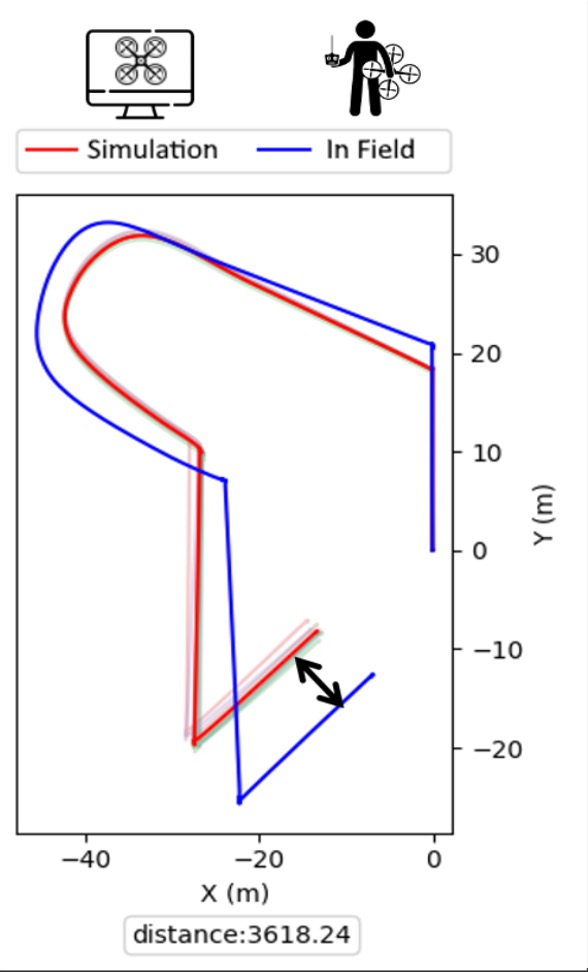
However, simulation-based testing introduces new challenges, particularly related to uncertainty and non-deterministic behaviors, where the same test case may produce different outcomes across executions.
Recent empirical studies show that uncertainty in UAV behavior can be a major contributor to unsafe outcomes, yet uncertainty is often treated implicitly or ignored in current testing pipelines. There is a lack of formal, explicit models that characterize uncertainty and safety jointly, and that can be systematically applied to UAV simulation data.